
Maslow's Hierarchy of Needs
What if your own development was not only dependent on you but on the fundamental needs present for every human being? What if understanding your needs made it easier to get closer to a feeling of well-being? Learn about Maslow’s hierarchy of needs.
Key takeaways
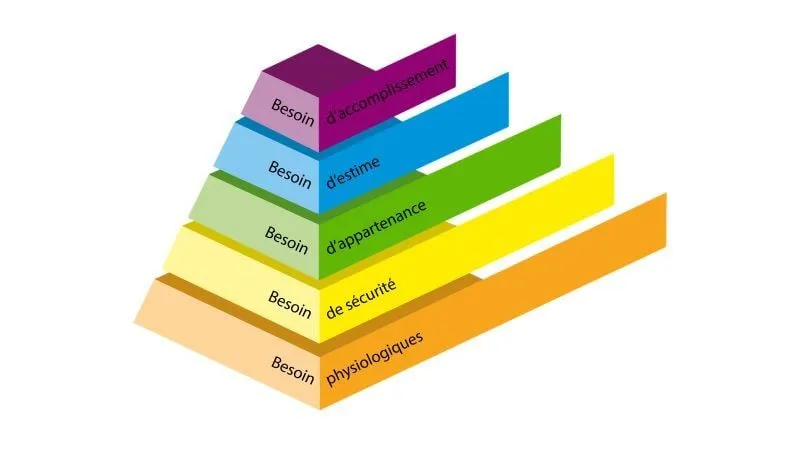
- Maslow's pyramid prioritizes 5 levels of needs: physiological, security, belonging, esteem, self-realization.
- Each level must be satisfied before accessing the next, according to the theory of Abraham Maslow (1950s).
- The model is criticized for its overly linear scheme and its lack of consideration of social relations and cultural variations.
- Understanding these needs helps to identify the levers of daily motivation and commitment.
1. WHAT IS MASLOW’S PRIORITIZATION OF NEEDS?
Maslow's hierarchy of needs was created by Abraham Maslow in the 1950s. Later, this theory was represented (wrongly) by a pyramid. This pyramid makes it possible to categorize the needs of individuals in the form of 5 different levels. This pyramid took shape by working on a theory of prioritizing the needs and motivations of individuals.
Needs are therefore central for Maslow. Its pyramid makes it possible to prioritize the needs of individuals. Indeed, even if each individual is unique, our needs are common to all. In order to be able to realize the different needs, those at lower levels must be satisfied beforehand. The satisfaction of these fundamental needs will allow the individual to access well-being.
2. MASLOW’S PYRAMID IN DETAIL
Here are the 5 needs named by Maslow
Physiological needs:
These needs constitute the foundation, the base of the pyramid. In these physiological needs therefore to maintain survival and the internal balance of the individual.
How to satisfy your physiological needs?
For example, we can find the act of eating, sleeping, drinking... If these needs are not satisfied, the individual will have the main motivation to achieve them, and will no longer leave room for other needs.
Security needs:
Once physiological needs are met, the individual can begin to realize some of their safety needs. The latter are part of a more social sphere, and will lead to specific behaviors which can vary from one culture to another. They will depend on the stability of the family circle, the level of income or the mental health of the individual. There are therefore two types of security, physical security and mental security.
How can we satisfy this need for security?
These needs include having housing security, job security or physical security. moral security… These needs can be satisfied individually or collectively
Social belonging needs:
These needs represent the third level of the pyramid. This level appeals to the social dimension of the individual. The need to belong is essential for the proper development of the individual. If this is not satisfied, the person can create an attachment or an excessive dependence which will lead to a loss of autonomy.
How can we satisfy this need for social belonging?
The person will need to feel accepted in a group, to feel loved, to have social status. So we all need love, affection, socialization, communication…
Esteem and self-esteem needs:
Once we are integrated into a society or group, we need to be recognized as our own entity, to be appreciated and esteemed. So we need to be considered by other people, to have respect and value.
This category also includes self-esteem, i.e. self-evaluation of ourselves. An individual who is esteemed by others may not have high self-esteem and vice versa.
How to satisfy this need for self-esteem?
Different means can satisfy these needs. There will be material needs (housing, car, etc.) and immaterial needs (social status, diploma, etc.). The means to satisfy self-esteem vary according to cultures, times and people. Self-esteem can be fulfilled by what we have or what we are.
Needs for self-realization and accomplishment:
This level is the 5th and final level of Maslow's pyramid of needs. Thus according to Maslow's theory, this can only be achieved if the previous 4 can be satisfied. Self-realization is an active and not a passive process. The goal is to act!
How to satisfy this need for self-realization?
Thus the individual needs to flourish, increase their knowledge, develop certain values, or achieve a personal objective. The person will seek to fulfill himself as such.
3. CRITICISMS OF MASLOW’S PYRAMID
The hierarchy of needs is subject to numerous criticisms from different professionals.
- Maslow does not sufficiently highlight the importance of social relations: Indeed, culture can modify the fundamental needs of this pyramid. If the individual finds himself in a collectivist society, for example, the group will have much greater importance than in an individualist society. Likewise, depending on the periods, geographical locations... The different needs will not have the same importance.
- A thinking of needs which is too linear and schematized: Human beings and their psychological processes are complex and cannot fit into well-defined cases. Some of our needs can manifest themselves jointly and not one after the other, having the same importance for the individual.
It is still important to nuance the hierarchy of needs. Maslow explains in particular that the emergence of needs does not occur suddenly and unexpectedly but appears little by little gradually. This means that as one need begins to be satisfied, the next one begins to surface little by little.
4. WHAT DOES MASLOW'S NEEDS PRIORITIZATION THEORY PROVIDE?
Maslow's hierarchy of needs is part of his motivation theory. Indeed, this pyramid allows us to understand what is hidden behind our motivations. Thus, better understanding the different needs of individuals would make it easier to find the levers of daily motivation and commitment. The more needs are satisfied, the more engaged the person will be in carrying out the task.
Conversely, if the previous needs are not sufficiently met, the person will show less commitment to the task, which can cause more difficulties with change.

C2Care, a leader in immersive technologies for mental health
Create your free account to explore over 250 virtual reality exposure situations and subscribe directly online.
Maslow's Hierarchy of Needs and Virtual Reality FAQ
Why use virtual reality in the field of mental health?
Virtual reality allows graduated and controlled exposure to anxiety-provoking situations, in a reproducible environment. It promotes patient engagement and personalized care. It applies to anxiety disorders, phobias, post-traumatic stress, obsessive-compulsive disorders, addictions and mood disorders.
How long has this existed?
C2Care has been testing its virtual reality exposure therapy software in hospitals since 2016. This experience is now based on more than 1,000 equipped practitioners and nearly 50 user countries.
What is a virtual environment?
A virtual environment is an immersive scene reproducing an anxiety-provoking situation (plane, crowd, spiders, public speaking, etc.). The practitioner uses it to expose the patient in a graduated manner to phobic stimuli, in a secure and reproducible setting.
What pathologies can be treated in virtual reality?
Virtual reality treats anxiety disorders (phobias, post-traumatic stress, obsessive-compulsive disorders), addictions, mood disorders and allows cognitive remediation. C2Care also offers dedicated applications, such as C2Nutri for eating disorders.
Can I feel nauseous while using the headset?
Cybersickness (nausea, disorientation) can occur in approximately 10% of virtual reality users. The practitioner adapts the intensity and duration of exposure to limit this effect and prioritize patient comfort.
Who can use virtual reality for treatment?
Practitioners such as psychologists, psychiatrists and occupational therapists use virtual reality in private practices or health establishments (CHU, hospitals, clinics, EHPAD, SSR) to offer exposure therapies to their patients.
Do I have access to all environments?
Yes. All C2Care environments are grouped together in a single application, accessible to the practitioner for all of their patients and their disorders.
Who should I contact if I have software problems?
The C2Care technical service can be reached via live chat from the control platform. In the event of a headset breakdown, a diagnosis is established with you, a return label provided if necessary, and the defective equipment replaced within 48 hours.
Author
C2Care
Related articles

Assertive communication
These days, communicating well is an essential skill. First of all, it is transversal and affects absolutely all areas of our lives. But above all, contemporary means of communication mean that we tend to be in continuous contact with others (via social networks in particular). Consequently, our ability to exchange and express our emotions as well as our ideas in a way that is healthy for ourselves and for others becomes essential for our well-being. This is precisely the purpose of assertive communication.

Constructed Emotion Theory
Many models try to explain the functioning and development of emotions. This recent model offers a new perspective on emotional skills and their cultural variations.

Therapy ACT
In mental health and in the context of psychotherapy, one element often comes up as a source of suffering: the need for control, and the distress it brings when, inevitably, certain elements escape this control, which can lead to a feeling of helplessness. The ACT is one of the tools to overcome this difficulty.

Emotional intelligence
Have you ever taken your stress or anger out on someone when it didn't come from them? Knowing how to accept and correctly manage your emotions is proof of emotional intelligence that is fundamental to success.

Self-determination
What if completing a task didn't depend solely on you? What if your personality was governed by fundamental psychological needs and responding to them leads you to personal fulfillment? Being self-determined means being able to respond to a feeling of freedom, interest, valuation and acceptance at the same time. Self-determination is then fundamental to our well-being.

Post-traumatic stress
We hear a lot about post-traumatic stress (PTSD), but what is it really? Can you suffer from post-traumatic stress even if you haven't actually experienced a traumatic event? We will try to answer all these questions together.