
Mental health and climate change
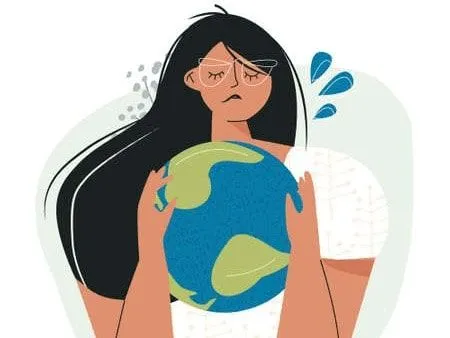
You may be wondering what link there may be between climate change and mental health? After all, how can one impact the other? The WHO (World Health Organization) indicates that climate change represents a significant risk for mental health. So in addition to impacting our planet, these changes will have an impact on anxiety, depression, violence and even post-traumatic stress.
Key takeaways
- Climate change promotes eco-anxiety and solastalgia, particularly among young people and people working in the climate sector.
- Climatic disasters (fires, floods, heatwaves) can generate direct or anticipated post-traumatic stress.
- A higher than normal temperature would increase interpersonal conflicts by 4% and conflicts between groups by 14%.
- Air pollution and rising temperatures are associated with increased depression, anxiety and suicide risk.
- Virtual reality allows progressive exposure to anxiety-provoking situations and the learning of emotion management tools.
1. HOW CAN CLIMATE IMPACT OUR MENTAL HEALTH?
Eco-anxiety / Solastalgia
The first people affected by this impact are those who have the most knowledge about climate change. Thus young people or people working in the climate environment find themselves particularly impacted by the latter.
Perhaps you have already heard the terms eco-anxiety and solastalgia. The two terms are closely related, even used in the same way. However, we can slightly differentiate them from each other.
Eco anxiety is a term used since the 90s while the concept of solastalgia arrived around 2003. Eco anxiety can be defined as a suffering linked to the projection on the future of global warming and a anxiety linked to its evolution, its changes...
A bit on the same principle as eco anxiety, solastalgia will mainly focus on the depressive symptoms caused by environmental/climatic changes.
Therapeutic support:
As seen previously, climate change has a significant impact on anxiety and depression. Therefore, therapeutic support may be necessary to help people manage their emotions such as anxiety. To do this, virtual reality makes it possible to expose the patient to situations that are anxiety-provoking or reminiscent of climate issues. Then during the exposures the therapist brings emotion management tools to the patient.
Post-traumatic stress
Post-traumatic stress linked to climate can be direct or anticipatory. Indeed, climate change increasingly favors climatic disasters (major fires, floods, heatwaves, etc.), which can leave traumatic after-effects in people who have directly experienced them.
We can also find anticipation of ecological catastrophe, which can itself promote the development of post-traumatic stress.
Therapeutic support:
In the context of post-traumatic stress following different types of climatic disasters, for example, therapy by exposure to virtual reality will make it possible to plunge the patient back into some of these traumatic places. Of course, the exposure is done progressively. As with the management of anxiety, the therapist will accompany the patient during these exposures in order to provide him with emotion management tools and to work on catastrophic thoughts. The environments created by virtual reality make it possible to get as close as possible to real environments to allow optimal exposure and support.
Violence
Perhaps by reading this title of “violence” you say to yourself, how can the climate impact violence? Many studies have focused on the effect of high heat (or, on the contrary, high coolness). A meta-analysis by 3 researchers from the University of Berkeley, notably demonstrated that a higher temperature than the normal season, increases the risks of interpersonal conflicts by 4% and the risks of conflicts between groups by 14%.
Perhaps you yourself have noticed that you are more sensitive and less patient when you are too hot or too cold?
Therapeutic support:
Different therapies can help with anger/violence management. As part of emotion management, virtual reality will allow the patient to be exposed to relaxation situations. Thanks to environments designed for relaxation, as well as the audios that accompany them, the therapist will support the patient in learning how to manage their anger.
Depression
Previously we talked about depression in the context of solastalgia. This time we are tackling depression linked to pollution together.
Indeed, a British study carried out over more than 7 years, with 13,000 people, shows a link between air pollution and an increase in the number of depression. This same study demonstrates a link with pollutants and increased anxiety and the risk of developing psychiatric pathologies such as schizophrenia. The study researchers explain that pollutants have significant inflammatory effects which promote psychotic and mood disorders.
Episodes of depression can also develop in connection with increased temperature. Indeed, we have known for a long time that high temperature conditions are very difficult psychologically. Indeed, many people fear that they will not tolerate the heat well, are afraid of having anxiety attacks, of suffocation, etc., which promotes depression as well as anxiety in these people.
In this pursuit, studies demonstrate an increase in the risk and number of suicides in connection with the increase in temperature.
Therapeutic support:
Virtual reality also has its place in the treatment of climate-related depression. Indeed, virtual reality will make it possible to use environments in the context of relaxation/meditation. Thus, patients will be immersed in virtual universes, which are ideal supports for learning relaxation, breathing techniques, letting go, etc. It will also make it possible to work on behavioral activation, by allowing the patient to re-expose themselves through virtual reality to different situations that are pleasant for them.
An example of physical impact: Medication and heat
What do drugs do in the context of climate?
Certain medications can worsen symptoms that can occur in heat, such as dehydration. Indeed, these medications can act on the regulation of body temperature. However, as we have just seen previously, the warmer people are, the more there is an impact on anxiety, depression, violence...
So with the increase in temperature, it will be necessary to think about readjusting the prescribed drug treatments.
In addition, certain medications can deteriorate with heat (such as liquids, suppositories, creams, etc.). The rest of the medications such as capsules, powders, etc. can also end up spoiling over time.
2. THERAPEUTIC MANAGEMENT
Here are some examples of the impact of climate on the mental health of individuals. As you will surely have understood, the consequences linked to the climate bring new therapeutic care. More and more people need to have this moment of listening, of discussing about their concerns, emotions... It is therefore important to support people in order to help them manage them and feel better on a daily basis!

C2Care, a leader in immersive technologies for mental health
Create your free account to explore over 250 virtual reality exposure situations and subscribe directly online.
FAQs on mental health, climate change and VRET
Why use virtual reality in the field of mental health?
Virtual reality allows graduated and controlled exposure to anxiety-provoking situations, in a secure and reproducible setting. It promotes patient engagement and adapts to their needs. She treats anxiety disorders, phobias, post-traumatic stress, OCD, addictions, mood disorders and cognitive remediation.
How long has this existed?
C2Care has been testing its virtual reality software in hospitals since 2016. This experience has since extended to more than 1,000 equipped practitioners in nearly 50 countries.
Can I feel nauseous while using the headset?
A minority of users may experience cybersickness, a sensation similar to motion sickness, during exposure. This phenomenon affects around 10% of people. The therapist adapts the progressiveness of the exposure to limit this discomfort.
Do I have access to all environments?
Yes, all C2Care environments are grouped into a single application. You therefore have single access to the entire catalog, without changing software depending on the disorder being treated.
Who should I contact if I have software problems?
Our technical service can be reached via live chat from your control platform. In the event of a VR headset failure, a diagnosis is carried out with you and the defective equipment is replaced within 48 hours if necessary.
Which patients can benefit from a VRET?
Patients suffering from eco-anxiety, climate disaster-related post-traumatic stress, depression, or climate-related anger management difficulties may benefit from virtual reality exposure therapy. The therapist adapts the environments to each situation.
Who can use virtual reality for treatment?
Virtual reality is aimed at practitioners, including psychologists, psychiatrists and occupational therapists. They supervise the exposure situations and adapt the environments to the needs of each patient as part of therapeutic care.
Can virtual reality be dangerous?
Virtual reality is not without effects: some patients may experience cybersickness, close to motion sickness, during exposure. This phenomenon affects around 10% of people. The therapist supervises each session to limit these inconveniences.
Author
C2Care
Related articles

Behavioral activation
Faced with depression and its negative symptoms, behavioral activation is today a first-line treatment whose effects continue to be highlighted in the scientific literature. Theorized in the 1950s, developed in the 1970s and popularized in the 1990s, behavioral activation shows effects equivalent to anti-depressants and cognitive therapy, while simplifying the patient's therapeutic path. Spotlight on this still little-known technique.

The TIPI method
Anxiety, sadness, anger are all negative emotions that can be difficult to manage and can impact our personal and professional lives. However, there are simple and quick methods that allow you to accept and deal with your emotions, so that they no longer impact our daily lives. Among them, the TIPI method.
What is the impact of Covid-19 on mental health?
The Covid-19 pandemic has had a significant impact on mental health, between fear, isolation and financial distress. This article reviews the main psychological effects of the health crisis and therapeutic solutions, including virtual reality exposure therapy (VRET), to help patients cope.

Virtual reality and social skills training with researchers from Aix-Marseille University.
A doctoral student in psychology in the Social Psychology Laboratory at the University of Aix-Marseille, I work with Dr Del-Monte, Ms Fauvarque, and Professor Graziani on virtual reality in the therapeutic context. In this context, I have had the pleasure of working for 3 years with C2Care software. The plurality and personalization of environments allowed me to have the freedom to direct my research in the desired direction without technological barriers.

Depression in the elderly
In recent years, the use of VR in geriatrics has grown considerably. As Mathias et al reported in a 2019 literature review, VR has become an effective tool for the screening and treatment of cognitive disorders, while it has also found uses in the treatment of Alzheimer's disease. The use of VR in treating mood disorders and other forms of depression in older adults has lagged, but there is reason to believe that it will be the next frontier in treating mental health disorders among older Americans. VR has been used with great success in the treatment of ADHD, anxiety and depression in adolescents and young people, leading many geriatric specialists to see exciting potential for older age groups. So let’s take a closer look at how this technology could be applied, and what kind of benefits older people can expect from it.