
Gender identity: better understanding to better support
Questions of gender identity and inclusiveness have been at the heart of the media landscape for several years. From a health point of view, transgender people often suffer from significant therapeutic wandering due to poor education on transidentity and lack of information from professionals. A short introduction to better understand gender identity and how to better care for trans people.
Key takeaways
- Gender is a social and psychological concept, distinct from biological sex.
- It consists of gender identity, gender expression, relationship to the body and gender roles.
- A transgender person has a discrepancy between their gender identity and the gender assigned at birth.
- Gender falls on a spectrum including non-binary and agender.
- Gender dysphoria is a determining factor in suicide risk; kindness, listening and acceptance are essential to support transgender patients.
1. WHAT IS GENDER?
gender is the set of processes and social relationships that serve to categorize humans. This categorization process is part of the cognitive functions that allow our brain to save part of its resources by simplifying the understanding of our environment. Most often, throughout history and cultures, the gender of individuals has been defined based on their sex.
Sex and gender are, however, two separate notions and very different.
Sex is a biological concept. It evolves between two modes (male and female) and is constructed from numerous physiological factors: chromosomes, genes, hormonal production, sexual organs and secondary sexual characteristics, mainly. There are therefore many variations in the biological expression of sex.
Gender is a social and psychological concept that evolves within a broad spectrum. It is mainly composed of four factors:
- Gender identity, that is to say a person's self-identification with one or more genders.
- Gender expression, that is to say the way in which an individual will modify their presentation in order to correspond to their gender. Clothing, haircut, makeup, jewelry, name and pronouns, etc.
- The relationship with the body, because the body we have may not correspond to the body associated with our gender identity, which can cause a very strong feeling of distress.
- Relationships to gender roles, strongly influenced by culture, and most often play a role in the male-female binary.
2. WHAT IS TRANSIDENTITY?
An individual's gender is often assigned at birth based on sex, but it is a part of identity that evolves enormously over the course of life.
Some of these developments are socially expected. A young boy's gender expression will not be the same as when he was a teenager, which will still be different from his gender expression as an adult.
If an individual's gender identity and gender expression follows the gender assigned at birth (male or female), we will speak of a cisgender person. Cisgender people are comfortable with this identity and their development follows what is expected and socially accepted.
However, for some people, there is a divergence between their gender identity and the gender assigned at birth. We will then speak of a transgender person.
The best known and most represented transidentity and binary transidentity: people assigned male at birth who transition to a female identity, and people assigned female at birth who transition to a male identity.
There is, however, a broader spectrum of gender identity between, and beyond, these two poles.
3. IS GENDER BINARY?
As we saw previously, the concept of gender is constructed from numerous factors, and as a result, all of these variations make gender a spectral concept.
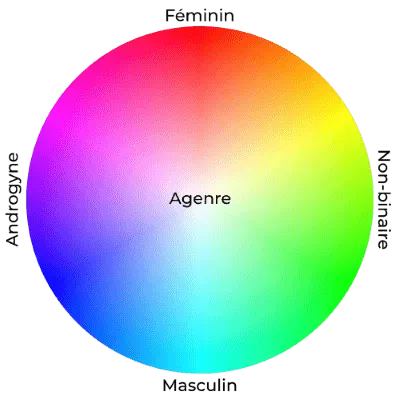
It is very difficult to represent this gender spectrum, but here is a simplified version:
In this representation, shades of red are feminine, shades of blue are masculine. Shades of pink and purple are therefore at the crossroads between these two genres, in the area of androgyny. Thus, just on this fairly binary aspect, we can observe a first spectrum.
In this representation, however, there are colors belonging neither to the blue family nor to the red family. It will be about non-binarity. non-binary trans people do not identify with traditional genders, and express their gender identity differently from the stereotypes expected of men and women. This expression can be closer to traditional genres, because existing fashion is very largely based on it for example, but these identities remain outside of this binary.
The last term represented in this image is the word “Agender” in the center, on white. In this view of gender, the intensity of color represents the intensity of identification with a gender. The more saturated the color, the stronger the identification. The lighter the color, the less strong the identification. Some people identify with no gender, or very weakly. Gender expression is of little importance to them, and how they are perceived has little importance.
This diagram allows us to understand in a pictorial way that gender is a question of nuances, which varies between each individual, most often in monochromes and rarely on a single color throughout life.
4. HOW TO HELP TRANSGENDER PEOPLE?
Thanks to a better understanding of transidentity in recent years, it is no longer considered a mental pathology in the major manuals of classification and diagnosis of diseases. However, transidentity can be a source of great suffering, particularly gender dysphoria.
It is an intense discomfort that occurs when gender expression does not correspond to gender identity. Dysphoria can be triggered by body appearance, clothing style, use of wrong pronouns or the wrong first name, anything reminiscent of the gender assigned at birth that does not correspond to the actual gender.
The best way to relieve dysphoria is obviously transition. It can be medical, with surgery, hormones and vocal rehabilitation, but also social, with clothing, the use of the chosen name and appropriate pronouns. It is important to note that transition does not have to be medical and that gender reassignment surgery is not necessary or desired by all transgender people.
Dysphoria is one of the most determining factors in the high rate of suicides and suicide attempts among transgender people. It is therefore important to assess suicidal ideation in patients with strong gender dysphoria.
In addition to supporting your transgender patients in their transition processes, providing them with moments of gender affirmation helps relieve dysphoria. use the right first name and pronouns (do not hesitate to ask for them if necessary) as well as offering them techniques for managing emotions and distress, because transitions are often long processes.
More generally, kindness, listening and acceptance are the key words in caring for a transgender patient. Their identity should not be questioned, nor their suffering. Their lives are often filled with varying degrees of violence, and the therapist must be a safe place to move forward and relieve their discomfort.

C2Care, a leader in immersive technologies for mental health
Create your free account to explore over 250 virtual reality exposure situations and subscribe directly online.
Gender Identity FAQ
What is the difference between sex and gender?
Sex is a biological concept, defined by physiological factors such as chromosomes or hormone production. Gender is a social and psychological concept, which evolves over a broad spectrum and is made up of four factors: identity, expression, relationship to the body and gender roles.
What is gender dysphoria?
Gender dysphoria is an intense discomfort that occurs when gender expression does not match gender identity. It can be triggered by bodily appearance, clothing style or the use of incorrect pronouns and first names, reminiscent of the gender assigned at birth.
Does the transition of a transgender person have to be medical?
No, the transition does not have to be medical. It can involve surgery, hormones or vocal rehabilitation, but also through social changes: clothing, chosen name and appropriate pronouns. Gender reassignment surgery is neither necessary nor desired by all transgender people.
Why is the risk of suicide higher among transgender people?
Gender dysphoria is one of the biggest contributors to the high rate of suicide and suicide attempts among transgender people. The practitioner must assess suicidal ideation in patients with severe gender dysphoria.
How can a practitioner support a transgender patient on a daily basis?
The practitioner must use the correct first name and pronouns, asking for them if necessary, and offer techniques for managing emotions and distress. Kindness, listening and acceptance are essential: the patient's identity and suffering must never be called into question.
What is a non-binary person?
A non-binary person does not identify with the traditional masculine or feminine genders. Its gender expression may come close to it, existing fashion being largely based on this binary, but its identity remains outside this framework.
Is trans identity considered a mental illness?
No, transidentity is no longer considered a mental pathology in the major manuals for the classification and diagnosis of diseases. However, it can be a source of great suffering, particularly through gender dysphoria, which must be supported clinically.
How can the Camille AI assistant support a person on these questions?
Camille represents a trusted person in whom the patient can confide without judgment. Integrated into virtual reality scenes, this AI assistant accompanies the patient throughout their journey, including on sensitive subjects such as gender identity.
Author
C2Care
Related articles
Dissociative identity disorder
Dissociative identity disorder or DID is a mental disorder that was previously called multiple personality disorder. This disorder is characterized by the presence of one or more alters (identities) who will take turns taking control of the person.

Self-stigma
Belonging to a minority group can be a source of great suffering. Most often, this suffering comes from outside, from majority groups or other minority groups. But the stress and suffering felt in relation to this status can also come from within. Low self-esteem, dysfunctional beliefs, repetition of toxic patterns, self-stigma adds additional suffering to the minority experience. It is interesting to understand how this mechanism works to better support people who suffer from it.
National Hypersensitivity Day
This day is an opportunity to revalue hypersensitivity. Launched by Saverio Tomasella, it helps to better inform managers on the characteristics and modalities of hypersensitivity. They represent a quarter of the population, there are almost 10 million in France. We must therefore now take into account the specific problems of hypersensitive people and their place in society.

Therapy ACT
In mental health and in the context of psychotherapy, one element often comes up as a source of suffering: the need for control, and the distress it brings when, inevitably, certain elements escape this control, which can lead to a feeling of helplessness. The ACT is one of the tools to overcome this difficulty.

Autism Spectrum Disorder
Autistic disorder, Asperger syndrome, Heller syndrome, Pervasive developmental disorder not otherwise specified: since the DSM-V all these qualifications have been grouped under the name ASD – Autism Spectrum Disorder. Is it a disease? What are the different shapes? How to detect it? Let's take stock of this disorder, which is still poorly understood today and which gives rise to a large number of questions and false beliefs.

assertiveness: communication technique
assertiveness is a major tool of cognitive-behavioral therapy, particularly suitable for patients suffering from social phobia. Finding the balance between expressing your needs and listening to those of others can be learned through precise verbal and non-verbal techniques. Discover, with Dr. Malbos, how to teach these basics to your patients and help them progress using virtual reality.